Someone asked me the other day why there had been no Indignant Citizen postings since April. I said, in my best Agent 86 voice, “Would you believe, a King Hell case of writer’s block?”
That’s a big part of it, the writer’s block. There is too much to write, and I often fear I can’t write any of it the way I want to, the way I see it written in my head. So I write nothing. Writer’s block, they say, can be tied to depression, to changes in the frontal lobe of the brain. Here’s what usually happens to me: During the day I get these great ideas for topics or plot lines. At work, I may jot them down or, if the inspiration has come from a magazine or newspaper article, I will put it in my bag, intending to take it out and write about it later. When I get home, I turn on the computer. Then I may make dinner, or watch a little TV to unwind. At some point I sit down at the computer and open a document. Almost immediately, sometimes before I type even a single word, I am overcome by fatigue. I stop. Then I begin surfing the Internet as a distraction, or I may return to watching TV.
Take right now, for example. Game 1 of the World Series is a blowout, with Boston killing Colorado 13-1. I have a load of laundry drying that doesn’t necessarily have to be folded before I go to bed. It’s 11:15 p.m. I am exhausted. I sat down to write about the transit funding clusterfuck in Springfield—an embarrassment on national and international levels—but all I can think about is how tired I am and how I have to get up and go to work in the morning.
And so what am I doing? Instead of writing about the transit funding fiasco, and how if the RTA entities are forced to carry out service cuts and fare hikes on the scale that has been discussed, someone will die—a kid forced to walk through gang territory because the bus he or she takes to school got cut, or a homeless person freezing to death waiting for a bus that never comes—and how as a result of that death or those deaths Gov. Blagojevich, House Speaker Madigan and Senate President Jones will have someone’s blood on their hands … instead of that I’m writing about writer’s block.
Writing about writer’s block may seem counterintuitive, but as it turns out it’s not that uncommon, they say. Hemingway did it. So did Freud and Kafka and Joseph Conrad. Look at Charlie Kaufman. He wrote a whole screenplay about writer’s block, a screenplay that was supposed to be an adaptation of Susan Orlean’s book “The Orchid Thief,” but that instead became the movie “Adaptation.”
I found “Adaptation” to be annoying. First of all, I enjoy Susan Orlean’s writing. I would have liked to have seen “The Orchid Thief” made into a movie that actually, you know, incorporated parts of the book. Second, how self-important does one have to be to turn a screenplay based on someone else’s book into a screenplay about oneself? And third … well, shit. What the hell? Who am I to write about what I didn’t like about “Adaptation?” I’ve just spent six paragraphs on my own writer’s block when what I intended to write about was transit.
And now it is 11:51 p.m. and I am totally awake, but can think of nothing but the fact that the alarm is going to go off in six hours.
Well maybe this is a start, at any rate.
The Indignant Citizen
Thursday, October 25, 2007
Saturday, April 28, 2007
The Most Important Movie of the Past 12 Months
Hollywood produces a lot of crap these days, unoriginal movies following formulaic scripts designed to rake in as much cash in as short a time as possible before fading into obscurity. Every once in a while, however, a movie hits theaters and delivers a message. “Shut Up & Sing” isn’t fiction, it’s real. It’s the story of what happened to the Dixie Chicks, the best selling female country music band of all time, when lead singer Natalie Maines stood at the front of a packed London concert hall in 2003, on the eve of the war in Iraq, and said the group was ashamed President Bush was from their home state of Texas.
I’m not sure what took me so long to see this movie … the fact that it was in theaters in Chicago for what seemed like two days late last year might account for the delay. But I finally saw it, and as you can guess from the title of this post, I think “Shut Up & Sing” is the most important American film of the past year. It may end up being the most important free speech documentary of the 21st century. This movie reveals the ugly side of America, the mouth breathing flag-suckers whose first instinct is to lash out at anyone who disagrees with them, as well as the money chasing entertainers and pundits who pander to this simpleton audience.
Everyone should see this movie. Even if you disagree with the Dixie Chicks, even if you threw out their CDs at one of the backwards radio station destruction parties, you need to see this movie. At its most basic level, “Shut Up & Sing” is about the power of words. Up a level from that, it’s about rhetoric, or the art of picking and choosing words to string together to deliver a message designed to promote an agenda.
Natalie Maines spoke off the cuff at that London concert. In the context of the European mood leading up to this stupid and endless war, Maines’ comment doesn’t seem like a big deal at all. Plenty of people in this country were saying worse things about Bush in the run-up to the invasion. But a certain element in this country took what Maines said, cast it in the light of an American speaking her mind overseas instead of in America, and used the predictable outcome for its own divisive purposes.
Before long the neo-patriots had whipped the usual suspects into an anti-liberal, anti-entertainment industry, anti-antiwar crowd frenzy. Free speech, we learn in the movie, is fine for number of Americans, so long as the people doing the speaking stick to an agreeable script. Additionally, we learn that members of the entertainment industry, indeed musicians from the same genre, will turn on colleagues like a wounded puma if they smell a quick buck in doing so.
I won’t go into all the details, or attempt to summarize “Shut Up & Sing” more than I have already. Just see this movie. See it, and ponder for a bit the definition of real courage. Real courage is sticking your neck out on the line—including risking your life—for something in which you believe, regardless of the consequences, or even in spite of them. That describes the men and women fighting and dying in this pointless conflict, and it describes some of those who have spoken out against it, and continue to speak out against it.
Me? I have nothing of great value to lose by describing this perpetual state of war, our dimwitted president and the knuckle-draggers who voted for him in terms I have already used. I don’t make my living in a public way and this forum reaches maybe half a dozen people, on a good day. The Dixie Chicks, however, risked everything. Maybe in the beginning it was unintentional—as I said, an off-the-cuff remark. But very quickly the Chicks made a choice to support one another and to move forward in their own way, beholden to no one, apologizing for nothing, fighting for what they believe in.
That’s America, people. At least, it’s the America I want to be associated with.
The Indignant Citizen
I’m not sure what took me so long to see this movie … the fact that it was in theaters in Chicago for what seemed like two days late last year might account for the delay. But I finally saw it, and as you can guess from the title of this post, I think “Shut Up & Sing” is the most important American film of the past year. It may end up being the most important free speech documentary of the 21st century. This movie reveals the ugly side of America, the mouth breathing flag-suckers whose first instinct is to lash out at anyone who disagrees with them, as well as the money chasing entertainers and pundits who pander to this simpleton audience.
Everyone should see this movie. Even if you disagree with the Dixie Chicks, even if you threw out their CDs at one of the backwards radio station destruction parties, you need to see this movie. At its most basic level, “Shut Up & Sing” is about the power of words. Up a level from that, it’s about rhetoric, or the art of picking and choosing words to string together to deliver a message designed to promote an agenda.
Natalie Maines spoke off the cuff at that London concert. In the context of the European mood leading up to this stupid and endless war, Maines’ comment doesn’t seem like a big deal at all. Plenty of people in this country were saying worse things about Bush in the run-up to the invasion. But a certain element in this country took what Maines said, cast it in the light of an American speaking her mind overseas instead of in America, and used the predictable outcome for its own divisive purposes.
Before long the neo-patriots had whipped the usual suspects into an anti-liberal, anti-entertainment industry, anti-antiwar crowd frenzy. Free speech, we learn in the movie, is fine for number of Americans, so long as the people doing the speaking stick to an agreeable script. Additionally, we learn that members of the entertainment industry, indeed musicians from the same genre, will turn on colleagues like a wounded puma if they smell a quick buck in doing so.
I won’t go into all the details, or attempt to summarize “Shut Up & Sing” more than I have already. Just see this movie. See it, and ponder for a bit the definition of real courage. Real courage is sticking your neck out on the line—including risking your life—for something in which you believe, regardless of the consequences, or even in spite of them. That describes the men and women fighting and dying in this pointless conflict, and it describes some of those who have spoken out against it, and continue to speak out against it.
Me? I have nothing of great value to lose by describing this perpetual state of war, our dimwitted president and the knuckle-draggers who voted for him in terms I have already used. I don’t make my living in a public way and this forum reaches maybe half a dozen people, on a good day. The Dixie Chicks, however, risked everything. Maybe in the beginning it was unintentional—as I said, an off-the-cuff remark. But very quickly the Chicks made a choice to support one another and to move forward in their own way, beholden to no one, apologizing for nothing, fighting for what they believe in.
That’s America, people. At least, it’s the America I want to be associated with.
The Indignant Citizen

Tuesday, March 13, 2007
The Reality Song
I don’t want to beat up on Garrett Kelleher and his Chicago Spire all the time, but the guy makes it so easy. Monday night he and architect Santiago Calatrava addressed a full house at the Chicago Architecture Foundation’s headquarters, ostensibly to present the building Kelleher wants to erect just west of Lake Shore Drive across from Navy Pier. Give Kelleher credit; it was nice of him and Calatrava to spend the time with the CAF members and docents discussing the Chicago Spire.
But the reality is all he has are drawings, and even those aren’t in final form yet. He hasn’t sold a single condominium unit and he has no outside investors, other than the bank that financed the land acquisition. Despite this, he insists he will break ground this spring. Don’t hold your breath.
At the CAF forum, Kelleher did not come across as any kind of sleazy developer. He seems like a genuinely nice and charming fellow, and he obviously has a strong desire to see this project completed. After all, as proposed the Chicago Spire would be by far the biggest jewel in his development portfolio, a career capper that would take its place in the Chicago skyline—the world’s best skyline—in between icons like the Sears Tower and the Hancock Center. But Kelleher has one problem he can’t avoid: He doesn’t have the money to build the thing.
A project like this, with 150 floors and some 1,300 condominiums, built in an unconventional style close to the lake on what is essentially very old landfill, could cost $2 billion, or more. Monday night, Kelleher admitted he’s paid for everything thus far, although he said Anglo Irish Bank is “fully committed” to the project. He did not explain what that means. In fact, he didn’t say much about the financing at all, and it was at this point during the meeting, the question-and-answer session, that Kelleher effected his best impersonation of a typical developer’s sleazy non-answer answers.
When asked about the nature of the financing, he said, with an Irish lilt, “Debt and equity. That’s about it.” Gee, thanks, professor. Debt and equity. That’s funny.
So who are his investors? Who’s committed money to this thing? Well, there’s himself and … Anglo Irish Bank. That’s it. Kelleher hasn’t even begun pre-selling the condo units. Later he said all of the money that has been spent thus far, for land acquisition and whatever architectural and engineering fees have accrued, has come from his own pocket. Kelleher is no doubt quite wealthy, and by many accounts he is a gutsy and shrewd businessman who has been underestimated any number of times, perhaps none moreso than when he burst on the scene in London in 2004 as the winning bidder (at €355 million, or about $468 million at today’s exchange rate) for the Lloyd’s of London building.
Other than financing the initial purchase of the property, the nature of Anglo Irish Bank’s commitment to the Chicago Spire project is unclear. The bank has a reputation for maintaining a fairly conservative financing portfolio, but last year it took a chance on a major renovation of the Palmer House Hilton by arranging nearly $363 million in financing for developer Joseph Sitt.
Anglo Irish Bank is making a push into the Chicago real estate market after opening an office here in October. It is Ireland’s third-largest bank, and has been performing well financially. In addition to the Palmer House financing, the bank recently put up nearly $93 million as part of a joint venture with Golub & Co. to buy 625 N. Michigan Ave. Golub, you may have heard, has its own problems, having been “removed” from the job of developing the residential portion of the long-troubled Block 37 project, according to a story in Tuesday’s Tribune.
The bank and Kelleher apparently have worked together before, according to a news release from Kelleher’s Shelbourne Development issued when Kelleher bought the 400 N. Lake Shore Drive property last year. The story of how Kelleher came to own the property says a great deal about how he’s approaching this project, it seems. As he related the story Monday night—and he has told the same story in the past—he happened to be in Chicago at about the time Christopher Carley of the Fordham Company, the spire’s original developer, was supposed to be closing on the deal to buy the land. Carley hit a snag, though, and as Kelleher said, “Without getting into details, circumstances presented themselves that I could close on the property in a short time. . . . I could buy it.” So he did. He learned about the opportunity on July 12, 2006 and closed the deal on the 20th, having done no due diligence other than look at a previously prepared environmental report. Then he went on vacation.
The site, he said, spoke for itself. It was a once-in-a-lifetime opportunity to build something grand in a stupendous location, and to work with Calatrava, who is generally referred to as one of these modern-day “starchitects” along the lines of Renzo Piano and Frank Gehry. Calatrava, for his part, had nothing but nice things to say about Kelleher, who is, of course, paying him. I suppose as long as Calatrava continues to get paid on time he will continue to have nice things to say about Kelleher.
Both men clearly see this as their big chance to impact the architecture and development worlds forevermore. A building like the Chicago Spire is the kind of structure that can define men, cities, even eras. If it gets built, that is, and there is still a mountain of evidence to suggest it won’t.
Last year Kelleher said he wanted to be in the ground with caissons by early 2007. In January he raised eyebrows, and a few hackles, at a meeting of the Grant Park Advisory Council by saying he would be starting to dig caissons within weeks, a statement that made it seem like he had the plan commission in his pocket and that approval was a slam dunk. Even in Chicago some folks—especially those who will live in the building’s shadow—didn’t take kindly to the notion that construction had already been approved. We do appreciate at least the appearance of due process here. At any rate, now here it is mid-March, nearly April, and still no caissons.
If I were a betting man, I would say this project would probably be approved by the mouth breathers at the Department of Planning and Development, despite the fact it’s totally out of scale with the surrounding area and will create a traffic nightmare in Streeterville. They probably like the renderings that show it in the skyline, and think it would perhaps add something to the city’s Olympic bid. But then the weeks will tick by and nothing will happen. Eventually the thing will die quietly and Kelleher will sell the land and something else, still probably too big and too expensive, will be built there.
And yet … and yet Kelleher keeps showing up in Chicago. Maybe he’s hoping to spur interest, and thus sales. More likely he genuinely believes construction will start any day. I think he’s sadly mistaken. A worst-case scenario would be he starts to dig, or maybe even gets a few floors built, before he runs out of money.
The world is about to change. We are groping through the twilight of the American Dream, or at least the perverted 20th Century version of the American Dream. It used to be the American Dream was that everyone could make it, could be successful, regardless of where he or she came from, or how poor. There were any number of different ways to measure “success” and somehow, probably through the co-opting of our lives by marketers, the dream morphed into just one measure of success: home ownership. As the century went, so went the American Dream and before long the dream became a McMansion in the suburbs and three SUVs.
And so it was that we became a disposable nation of cheaply-built strip malls, drive-through fried food emporiums, cinder block warehouse stores and slapdash houses. Everyone deserved a shot at this new American Dream, just like every student deserves an “A.” In the grand tradition of the American West, mortgage speculators appeared offering 100% financing to everyone at appealingly low interest rates. Well, they were appealingly low so long as the Federal Reserve didn’t get uppity. But the Fed did get uppity and now those so-called adjustable rate mortgages have adjusted—upward. One result of that is a growing number of defaults on what are known as sub-prime mortgages, in other words risky home loans that in any moderately intelligent climate never would have been approved in the first place.
And so now we get to ask which is worse: never having the chance to own a home, or having your home taken from you when your minimum-wage jobs as a clerk at Wal-Mart and a grillman at Wendy’s don’t provide enough money to keep up with the rising monthly payments?
Ah, but never mind. We were talking about the Chicago Spire, not the American Dream. Except that the Chicago Spire is Garrett Kelleher’s American Dream, and probably Santiago Calatrava’s, too. And for between $1,200 and $9,000 per square foot—Kelleher’s giggle-inducing price range—the condos could be versions of the American Dream for thousands of residents. That’s certainly what Kelleher is expecting. He said everywhere he goes around the world, the Chicago Spire generates interest. People apparently are excited to think about living there, although probably not full time. The answer to the oft-asked (at least by me) question, “Who’s going to buy all these condos they’re building all over the city?” is apparently “Very rich people who want a second, or third, home.”
There exists right now in this country a massive amount of disposable income, across various social strata. A great many more people have a lot of money now than did, say 10 years ago. And the elite who already had a lot of money 10 years ago now have a great deal more than they did then, provided they aren’t in jail.
Condos and houses are to the rich today what cars were 25 years ago. You own three or four, in different places, and use whichever one happens to be in the place you want to go at that particular time. You want a weekend in New York, you fly in and stay in your condo on Central Park West. Gonna be in Aspen? Fly in and drive to your cabin there. Coming to the Taste of Chicago, just come downtown and “check in” to your very own place, which otherwise stays dark 300 days out of the year. What a wonderful sense of community that builds, eh?
And when some or a lot of that wealth, much of it based on derivatives contracts that, in a financial crisis, won’t be worth the paper they’re printed on, evaporates, what will become of all these new high-rise condominiums? I suppose they’ll be dark the other 65 days out of the year.
But we’ve gotten off the topic again. My feelings about the Chicago Spire are no secret (see “Chicago Uninspired”). Nothing presented at the CAF meeting Monday night changed my mind. Calatrava is living in a dream world. He interspersed his rough watercolor renderings of the nearby planned DuSable Park with photos of Zurich, where he lives now. Many of the ground-level perspectives didn’t represent reality in terms of what effect the presence of a 150-story tower would have. Calatrava kept saying he wanted the lobby to be transparent. He wants glass walls and artwork inside and a big plaza. That’s fine. But what about that giant twisting dildo looming over everyone and everything? The height it, and its mass, do affect the surrounding area, no matter how glassy the lobby is.
Calatrava mentioned he wants seven massive building supports in the lobby. Seven. For the whole building. One bomb and suddenly there are six supports, folks. So, either the plaza isn’t going to be as accessible as it has been presented, or the lobby isn’t going to be as transparent. When you build something like this, security does enter into the equation. Just ask the folks in charge of the Freedom Tower in New York City. That thing is a 1,400-foot-tall obelisk sitting on a 300-foot high impenetrable pedestal. That should relate to the street nicely, don’t you think?
The other thing about showing slides of the park in Zurich, and of Zurich neighborhoods, is that it leaves out the bald fact that Zurich is a traditional old European city full of low- and mid-rise buildings. There are no 150-story skyscrapers casting shadows and looming over everything. Good planning is about context, and so far none of the renderings of the Chicago Spire have offered anything resembling context. Calatrava talked a lot about a “symbiotic relationship” between the tower and the site, but none of the drawings he showed explained how that would work. He showed some photos of his “Turning Torso” skyscraper in Malmo, Sweden, but those only served as examples of a stark out-of-context design. See for yourself.
The long and the short of it is Kelleher can’t build this as things stand now. I don’t expect circumstances to change much for the better. Economically things may actually get much worse, but I’d be surprised if they stayed the same or changed in a way that allowed this project to move forward. There is no doubt Kelleher and Calatrava are committed to the Chicago Spire; they proved that much Monday night at the CAF meeting. But sooner or later reality is going to collide with ambition. To paraphrase John Cougar Mellencamp, when you fight reality, reality always wins.
The Indignant Citizen
But the reality is all he has are drawings, and even those aren’t in final form yet. He hasn’t sold a single condominium unit and he has no outside investors, other than the bank that financed the land acquisition. Despite this, he insists he will break ground this spring. Don’t hold your breath.
At the CAF forum, Kelleher did not come across as any kind of sleazy developer. He seems like a genuinely nice and charming fellow, and he obviously has a strong desire to see this project completed. After all, as proposed the Chicago Spire would be by far the biggest jewel in his development portfolio, a career capper that would take its place in the Chicago skyline—the world’s best skyline—in between icons like the Sears Tower and the Hancock Center. But Kelleher has one problem he can’t avoid: He doesn’t have the money to build the thing.
A project like this, with 150 floors and some 1,300 condominiums, built in an unconventional style close to the lake on what is essentially very old landfill, could cost $2 billion, or more. Monday night, Kelleher admitted he’s paid for everything thus far, although he said Anglo Irish Bank is “fully committed” to the project. He did not explain what that means. In fact, he didn’t say much about the financing at all, and it was at this point during the meeting, the question-and-answer session, that Kelleher effected his best impersonation of a typical developer’s sleazy non-answer answers.
When asked about the nature of the financing, he said, with an Irish lilt, “Debt and equity. That’s about it.” Gee, thanks, professor. Debt and equity. That’s funny.
So who are his investors? Who’s committed money to this thing? Well, there’s himself and … Anglo Irish Bank. That’s it. Kelleher hasn’t even begun pre-selling the condo units. Later he said all of the money that has been spent thus far, for land acquisition and whatever architectural and engineering fees have accrued, has come from his own pocket. Kelleher is no doubt quite wealthy, and by many accounts he is a gutsy and shrewd businessman who has been underestimated any number of times, perhaps none moreso than when he burst on the scene in London in 2004 as the winning bidder (at €355 million, or about $468 million at today’s exchange rate) for the Lloyd’s of London building.
Other than financing the initial purchase of the property, the nature of Anglo Irish Bank’s commitment to the Chicago Spire project is unclear. The bank has a reputation for maintaining a fairly conservative financing portfolio, but last year it took a chance on a major renovation of the Palmer House Hilton by arranging nearly $363 million in financing for developer Joseph Sitt.
Anglo Irish Bank is making a push into the Chicago real estate market after opening an office here in October. It is Ireland’s third-largest bank, and has been performing well financially. In addition to the Palmer House financing, the bank recently put up nearly $93 million as part of a joint venture with Golub & Co. to buy 625 N. Michigan Ave. Golub, you may have heard, has its own problems, having been “removed” from the job of developing the residential portion of the long-troubled Block 37 project, according to a story in Tuesday’s Tribune.
The bank and Kelleher apparently have worked together before, according to a news release from Kelleher’s Shelbourne Development issued when Kelleher bought the 400 N. Lake Shore Drive property last year. The story of how Kelleher came to own the property says a great deal about how he’s approaching this project, it seems. As he related the story Monday night—and he has told the same story in the past—he happened to be in Chicago at about the time Christopher Carley of the Fordham Company, the spire’s original developer, was supposed to be closing on the deal to buy the land. Carley hit a snag, though, and as Kelleher said, “Without getting into details, circumstances presented themselves that I could close on the property in a short time. . . . I could buy it.” So he did. He learned about the opportunity on July 12, 2006 and closed the deal on the 20th, having done no due diligence other than look at a previously prepared environmental report. Then he went on vacation.
The site, he said, spoke for itself. It was a once-in-a-lifetime opportunity to build something grand in a stupendous location, and to work with Calatrava, who is generally referred to as one of these modern-day “starchitects” along the lines of Renzo Piano and Frank Gehry. Calatrava, for his part, had nothing but nice things to say about Kelleher, who is, of course, paying him. I suppose as long as Calatrava continues to get paid on time he will continue to have nice things to say about Kelleher.
Both men clearly see this as their big chance to impact the architecture and development worlds forevermore. A building like the Chicago Spire is the kind of structure that can define men, cities, even eras. If it gets built, that is, and there is still a mountain of evidence to suggest it won’t.
Last year Kelleher said he wanted to be in the ground with caissons by early 2007. In January he raised eyebrows, and a few hackles, at a meeting of the Grant Park Advisory Council by saying he would be starting to dig caissons within weeks, a statement that made it seem like he had the plan commission in his pocket and that approval was a slam dunk. Even in Chicago some folks—especially those who will live in the building’s shadow—didn’t take kindly to the notion that construction had already been approved. We do appreciate at least the appearance of due process here. At any rate, now here it is mid-March, nearly April, and still no caissons.
If I were a betting man, I would say this project would probably be approved by the mouth breathers at the Department of Planning and Development, despite the fact it’s totally out of scale with the surrounding area and will create a traffic nightmare in Streeterville. They probably like the renderings that show it in the skyline, and think it would perhaps add something to the city’s Olympic bid. But then the weeks will tick by and nothing will happen. Eventually the thing will die quietly and Kelleher will sell the land and something else, still probably too big and too expensive, will be built there.
And yet … and yet Kelleher keeps showing up in Chicago. Maybe he’s hoping to spur interest, and thus sales. More likely he genuinely believes construction will start any day. I think he’s sadly mistaken. A worst-case scenario would be he starts to dig, or maybe even gets a few floors built, before he runs out of money.
The world is about to change. We are groping through the twilight of the American Dream, or at least the perverted 20th Century version of the American Dream. It used to be the American Dream was that everyone could make it, could be successful, regardless of where he or she came from, or how poor. There were any number of different ways to measure “success” and somehow, probably through the co-opting of our lives by marketers, the dream morphed into just one measure of success: home ownership. As the century went, so went the American Dream and before long the dream became a McMansion in the suburbs and three SUVs.
And so it was that we became a disposable nation of cheaply-built strip malls, drive-through fried food emporiums, cinder block warehouse stores and slapdash houses. Everyone deserved a shot at this new American Dream, just like every student deserves an “A.” In the grand tradition of the American West, mortgage speculators appeared offering 100% financing to everyone at appealingly low interest rates. Well, they were appealingly low so long as the Federal Reserve didn’t get uppity. But the Fed did get uppity and now those so-called adjustable rate mortgages have adjusted—upward. One result of that is a growing number of defaults on what are known as sub-prime mortgages, in other words risky home loans that in any moderately intelligent climate never would have been approved in the first place.
And so now we get to ask which is worse: never having the chance to own a home, or having your home taken from you when your minimum-wage jobs as a clerk at Wal-Mart and a grillman at Wendy’s don’t provide enough money to keep up with the rising monthly payments?
Ah, but never mind. We were talking about the Chicago Spire, not the American Dream. Except that the Chicago Spire is Garrett Kelleher’s American Dream, and probably Santiago Calatrava’s, too. And for between $1,200 and $9,000 per square foot—Kelleher’s giggle-inducing price range—the condos could be versions of the American Dream for thousands of residents. That’s certainly what Kelleher is expecting. He said everywhere he goes around the world, the Chicago Spire generates interest. People apparently are excited to think about living there, although probably not full time. The answer to the oft-asked (at least by me) question, “Who’s going to buy all these condos they’re building all over the city?” is apparently “Very rich people who want a second, or third, home.”
There exists right now in this country a massive amount of disposable income, across various social strata. A great many more people have a lot of money now than did, say 10 years ago. And the elite who already had a lot of money 10 years ago now have a great deal more than they did then, provided they aren’t in jail.
Condos and houses are to the rich today what cars were 25 years ago. You own three or four, in different places, and use whichever one happens to be in the place you want to go at that particular time. You want a weekend in New York, you fly in and stay in your condo on Central Park West. Gonna be in Aspen? Fly in and drive to your cabin there. Coming to the Taste of Chicago, just come downtown and “check in” to your very own place, which otherwise stays dark 300 days out of the year. What a wonderful sense of community that builds, eh?
And when some or a lot of that wealth, much of it based on derivatives contracts that, in a financial crisis, won’t be worth the paper they’re printed on, evaporates, what will become of all these new high-rise condominiums? I suppose they’ll be dark the other 65 days out of the year.
But we’ve gotten off the topic again. My feelings about the Chicago Spire are no secret (see “Chicago Uninspired”). Nothing presented at the CAF meeting Monday night changed my mind. Calatrava is living in a dream world. He interspersed his rough watercolor renderings of the nearby planned DuSable Park with photos of Zurich, where he lives now. Many of the ground-level perspectives didn’t represent reality in terms of what effect the presence of a 150-story tower would have. Calatrava kept saying he wanted the lobby to be transparent. He wants glass walls and artwork inside and a big plaza. That’s fine. But what about that giant twisting dildo looming over everyone and everything? The height it, and its mass, do affect the surrounding area, no matter how glassy the lobby is.
Calatrava mentioned he wants seven massive building supports in the lobby. Seven. For the whole building. One bomb and suddenly there are six supports, folks. So, either the plaza isn’t going to be as accessible as it has been presented, or the lobby isn’t going to be as transparent. When you build something like this, security does enter into the equation. Just ask the folks in charge of the Freedom Tower in New York City. That thing is a 1,400-foot-tall obelisk sitting on a 300-foot high impenetrable pedestal. That should relate to the street nicely, don’t you think?
The other thing about showing slides of the park in Zurich, and of Zurich neighborhoods, is that it leaves out the bald fact that Zurich is a traditional old European city full of low- and mid-rise buildings. There are no 150-story skyscrapers casting shadows and looming over everything. Good planning is about context, and so far none of the renderings of the Chicago Spire have offered anything resembling context. Calatrava talked a lot about a “symbiotic relationship” between the tower and the site, but none of the drawings he showed explained how that would work. He showed some photos of his “Turning Torso” skyscraper in Malmo, Sweden, but those only served as examples of a stark out-of-context design. See for yourself.
The long and the short of it is Kelleher can’t build this as things stand now. I don’t expect circumstances to change much for the better. Economically things may actually get much worse, but I’d be surprised if they stayed the same or changed in a way that allowed this project to move forward. There is no doubt Kelleher and Calatrava are committed to the Chicago Spire; they proved that much Monday night at the CAF meeting. But sooner or later reality is going to collide with ambition. To paraphrase John Cougar Mellencamp, when you fight reality, reality always wins.
The Indignant Citizen
Tuesday, January 30, 2007
Chicago Uninspired
It’s time someone called “bullshit” on this catastrophic waste of time and materials that developer Garrett Kelleher and architect Santiago Calatrava are trying to foist on Chicago. The “Chicago Spire,” a 2,000-foot drill-bit condo on the lakefront is an af-front to sensible planning and good architecture.

The fact that all the renderings of the Chicago Spire are from the same impossible perspective, suspended 1,500 feet above Lake Michigan, a mile offshore, tells you all you need to know about how poorly this project has been conceived. Buildings are about more than how they look in the skyline; they are about how they relate to the street, and to the buildings around them. This building doesn’t fit.
Let’s leave aside the practical obstacles Kelleher has to overcome, such as, oh, say, financing, and concentrate on it as a design exercise. Calatrava is one of these new “starchitects,” men whose projects elicit knee-jerk knob-slobbing reviews by architecture critics the world over, including here, based more on the name on the drawings than the substance of them. Sure, the Tribune’s Blair Kamin got huffy with Calatrava and Kelleher after a meeting of the Grant Park Advisory Council. There was some dispute as to whether the developer and the architect were showing the public the most recent renderings of the building, and whether Kelleher had changed the design and was now trying to ram it through the plan commission without allowing for a proper airing of this most public of projects.
Subsequent to that meeting, Kelleher and Calatrava sat down with Kamin and showed him the latest drawings, which Kamin deemed a huge improvement over the last renderings, proclaiming it “skyline sizzle.” Please, someone get that man a towel.
This thing is ridiculous. Kelleher wants to put 1,300 condominiums on a spit of land just west of Lake Shore Drive, in a neighborhood that until recently didn’t even have a decent grocery store. It is an insanely oversized project of exactly the type that will suffer the greatest hardship in a post-cheap oil economy. “Gee, honey, the power is out again today. Third time this week. Guess we’ll have to walk up to the 150th floor.” And I wonder how the water pressure will be up there during the rolling blackouts. . . .
Well, that all sounds vaguely doomsday, eh? Let’s be more practical. It is totally out of scale with anything around it. It fails to respect anything about its location. It’s twisting shape is a gimmick; Kamin writes that it whirls “into the sky with the same exuberant energy as the beloved, romantic skyscrapers of the 1920s.” BullSHIT. It still looks like a giant silver Twizzler stick. In fact, why not just paint it red and be done with it. They could even paint a Twizzler wrapper on it and call it advertising. A capitalistic move like that might even bring in enough advance money to start building the thing.
It’s out of proportion. And for those of you who tempted to say, “Yeah, well then so was the Hancock when it was built,” you’re right. It was. But that was another era, when super tall buildings took your breath away, and everyone was reaching higher. Now on the eve of a permanent energy shortage, projects like the Chicago Spire, and Taipei 101 and the new thing in Dubai seem more like last, wheezing grasps at a brass ring that’s moving a hundred miles an hour away from us.
What we need are not mega-tall structures with 1,300 luxury condos; we need to replace the affordable housing that’s been torn down by the Chicago Housing Authority and the reasonable rental units and housing being lost to creeping gentrification. (Not that gentrification is bad from the standpoint of improving neighborhoods, but the poor have to live somewhere—isn’t it better for them to be scattered among us than concentrated in pockets of poverty? That generally hasn’t worked out so well in the past.) And we need buildings that relate to the street and to the people using those streets.
The Chicago Spire does none of those things. Its sole attribute is that it looks cool in computer simulations of the skyline. People don’t live in the skyline, though. They live on the ground, and that’s where this building fails unforgivably.
The Indignant Citizen

The fact that all the renderings of the Chicago Spire are from the same impossible perspective, suspended 1,500 feet above Lake Michigan, a mile offshore, tells you all you need to know about how poorly this project has been conceived. Buildings are about more than how they look in the skyline; they are about how they relate to the street, and to the buildings around them. This building doesn’t fit.
Let’s leave aside the practical obstacles Kelleher has to overcome, such as, oh, say, financing, and concentrate on it as a design exercise. Calatrava is one of these new “starchitects,” men whose projects elicit knee-jerk knob-slobbing reviews by architecture critics the world over, including here, based more on the name on the drawings than the substance of them. Sure, the Tribune’s Blair Kamin got huffy with Calatrava and Kelleher after a meeting of the Grant Park Advisory Council. There was some dispute as to whether the developer and the architect were showing the public the most recent renderings of the building, and whether Kelleher had changed the design and was now trying to ram it through the plan commission without allowing for a proper airing of this most public of projects.
Subsequent to that meeting, Kelleher and Calatrava sat down with Kamin and showed him the latest drawings, which Kamin deemed a huge improvement over the last renderings, proclaiming it “skyline sizzle.” Please, someone get that man a towel.
This thing is ridiculous. Kelleher wants to put 1,300 condominiums on a spit of land just west of Lake Shore Drive, in a neighborhood that until recently didn’t even have a decent grocery store. It is an insanely oversized project of exactly the type that will suffer the greatest hardship in a post-cheap oil economy. “Gee, honey, the power is out again today. Third time this week. Guess we’ll have to walk up to the 150th floor.” And I wonder how the water pressure will be up there during the rolling blackouts. . . .
Well, that all sounds vaguely doomsday, eh? Let’s be more practical. It is totally out of scale with anything around it. It fails to respect anything about its location. It’s twisting shape is a gimmick; Kamin writes that it whirls “into the sky with the same exuberant energy as the beloved, romantic skyscrapers of the 1920s.” BullSHIT. It still looks like a giant silver Twizzler stick. In fact, why not just paint it red and be done with it. They could even paint a Twizzler wrapper on it and call it advertising. A capitalistic move like that might even bring in enough advance money to start building the thing.
It’s out of proportion. And for those of you who tempted to say, “Yeah, well then so was the Hancock when it was built,” you’re right. It was. But that was another era, when super tall buildings took your breath away, and everyone was reaching higher. Now on the eve of a permanent energy shortage, projects like the Chicago Spire, and Taipei 101 and the new thing in Dubai seem more like last, wheezing grasps at a brass ring that’s moving a hundred miles an hour away from us.
What we need are not mega-tall structures with 1,300 luxury condos; we need to replace the affordable housing that’s been torn down by the Chicago Housing Authority and the reasonable rental units and housing being lost to creeping gentrification. (Not that gentrification is bad from the standpoint of improving neighborhoods, but the poor have to live somewhere—isn’t it better for them to be scattered among us than concentrated in pockets of poverty? That generally hasn’t worked out so well in the past.) And we need buildings that relate to the street and to the people using those streets.
The Chicago Spire does none of those things. Its sole attribute is that it looks cool in computer simulations of the skyline. People don’t live in the skyline, though. They live on the ground, and that’s where this building fails unforgivably.
The Indignant Citizen
Monday, January 22, 2007
Bearssss
 hicago will have to put off its collective nervous breakdown for another week. That Rex Grossman doll, waiting to be hung in effigy, stick it back in the closet. The Chicago Bears are going to the Super Bowl. They beat New Orleans 39-14 at a snowy Soldier Field Sunday afternoon to win their first NFC title in 21 years.
On Feb. 4 the Bears will play the Indianapolis Colts in Miami. Once again they will be underdogs. They already are. The strange world of sports betting and prognosticating has the Colts by 7. That’s a touchdown the Bears are giving up to the Colts, who needed to stage the biggest comeback in conference championship history to beat the New England Patriots in Indianapolis Sunday night.
Meanwhile, except for a brief time late in the second quarter and for part of the third, when the Saints made a game of it, the Bears monkey-stomped New Orleans. They ran the ball down their throats, and beat the holy living shit out of them on defense. All the while the glorious snow fell from the sky, adding another 10 years at least to the mystique of “Bears Weather.” Of course, at the rate we’re going, Chicago will have Miami’s climate by the time the Bears make the Super Bowl again, but what the hell? The Bears are in the Super Bowl.
The Indignant Citizen
Wednesday, January 17, 2007
The Weird Wisdom of Hal Slocumb
Where has all the indignation gone, long time passing?
Well, it hasn’t gone anywhere, per se, it has been submerged beneath other issues, serious and real issues that remain issues and remain serious. But that pot of spaghetti sauce is starting to boil over. The stove is getting crusty.
Twenty thousand additional troops are headed to Iraq to fight in the War Without End, but Preznitwit Bush says it’s not an escalation. It is a “surge.” Perhaps “thrust” is a more appropriate word, because someone’s getting fucked here. Oh yes, it’s us, the American people. History will look back on us unkindly, no doubt, and quite possibly judge us more harshly than our dimwit commander-and-thief. Because while our overeducated ranch hand president deserves the blame for conducting perhaps the most poorly conceived military campaign since the opening of the Eastern Front in World War 2, we elected him. Twice.
OK, to be fair we didn’t elect him the first time, at least not by any kind of popular vote. But the second time around we gave him the green light, and not only that we cleared traffic off the streets and fired all the police. Since 2004, it’s been pedal-to-the-metal straight down Main Street belching flame out the exhaust pipe. History will remember us as the people that elevated a failed businessman and dimwitted evangelist to the most powerful office on Earth, and watched for six years as he and those acting on his behalf looted the country and declared war on rest of the world, in God’s name.
This is the man who, when his generals told him they needed more troops, tried to make do with fewer. Now, when the commanders on the ground say reductions in force are appropriate, he sends more, and replaces the commanders who disagree with him. What are we to make of a commander-in-chief who ties the hands of his own military? What indeed. . . .
Like it or not, however, we are stuck with him for the foreseeable future. Even beyond that, few viable options have presented themselves. Illinois Senator Barack Obama wants to run for president as a Democrat. But the only thing we can say with any certainty about Sen. Obama is that he is very, very good at being Sen. Obama. His judgment on other issues, such as choosing real estate partners (Tony Rezko), or endorsing candidates (Todd Stroger), or accepting support (Mayor Daley) is open to questioning.
There is something more than mildly distasteful about the amount of hype surrounding Sen. Obama. It isn’t that he doesn’t seem to be a likeable guy. No doubt he is. But he hasn’t done anything. The Tribune’s John Kass puts it very well in his column: “… all these people, who don’t really know him, pouring their ambitions into his empty vessel.”
Such is the condition in which we find ourselves today, nearly 22 months before the next election. We are so starved for real leadership, for any sign of electrical activity in the brain of the man behind the podium, that we will eagerly pour our hopes and ambitions into the empty vessel of the first best looking thing that comes along. The sad part is, Obama can’t even control his own fate any more. His candidacy is no longer in his hands; Obama’s future is now controlled by a pack of thin-skinned and eager political reporters and pundit hacks who will fawn over him so long as he pleases them, but who won’t hesitate to skewer him at the first perceived slight or sign of danger.
The pack also likes, on occasion, to tear down what it has built up, and so there is a real possibility that, six months down the road, the popularity pendulum will begin its movement back toward the center, inevitably missing the center, as pendulums always do, and swinging over to personal destruction. The ultimate outcome of an Obama presidential run may be decided before a single straw poll or caucus is held. This is the New America: faster and more efficient, able to weed out presidential candidates with the click of a mouse.
There are two main concerns about Obama: One is that he is all flash and no substance, and the other is that there is real substance there, but it will be burned up by the flash. But we live in a fantasy land here in America, with an imagined economy and delusional leadership. So it makes perfect sense that we would embrace Obama at this early stage. He is a fantasy, he is a dream. Right now, he is whatever we want him to be—a strong leader, eloquent, pragmatic, intelligent, sexy. Whether he actually is any of those things right now is irrelevant. It only matters what we perceive, what we believe. Maybe Obama is smart. Maybe he’s just been lucky. Maybe he’s smart and lucky.
Either way, the trouble with living in a fantasy land is that eventually reality intrudes. Like Harvey Keitel’s character Hal Slocumb said in the movie “Thelma & Louise”:

“Brains will only get you so far, and luck always runs out.”
The same is true for countries, as well as politicians and fugitives.
The Indignant Citizen
Well, it hasn’t gone anywhere, per se, it has been submerged beneath other issues, serious and real issues that remain issues and remain serious. But that pot of spaghetti sauce is starting to boil over. The stove is getting crusty.
Twenty thousand additional troops are headed to Iraq to fight in the War Without End, but Preznitwit Bush says it’s not an escalation. It is a “surge.” Perhaps “thrust” is a more appropriate word, because someone’s getting fucked here. Oh yes, it’s us, the American people. History will look back on us unkindly, no doubt, and quite possibly judge us more harshly than our dimwit commander-and-thief. Because while our overeducated ranch hand president deserves the blame for conducting perhaps the most poorly conceived military campaign since the opening of the Eastern Front in World War 2, we elected him. Twice.
OK, to be fair we didn’t elect him the first time, at least not by any kind of popular vote. But the second time around we gave him the green light, and not only that we cleared traffic off the streets and fired all the police. Since 2004, it’s been pedal-to-the-metal straight down Main Street belching flame out the exhaust pipe. History will remember us as the people that elevated a failed businessman and dimwitted evangelist to the most powerful office on Earth, and watched for six years as he and those acting on his behalf looted the country and declared war on rest of the world, in God’s name.
This is the man who, when his generals told him they needed more troops, tried to make do with fewer. Now, when the commanders on the ground say reductions in force are appropriate, he sends more, and replaces the commanders who disagree with him. What are we to make of a commander-in-chief who ties the hands of his own military? What indeed. . . .
Like it or not, however, we are stuck with him for the foreseeable future. Even beyond that, few viable options have presented themselves. Illinois Senator Barack Obama wants to run for president as a Democrat. But the only thing we can say with any certainty about Sen. Obama is that he is very, very good at being Sen. Obama. His judgment on other issues, such as choosing real estate partners (Tony Rezko), or endorsing candidates (Todd Stroger), or accepting support (Mayor Daley) is open to questioning.
There is something more than mildly distasteful about the amount of hype surrounding Sen. Obama. It isn’t that he doesn’t seem to be a likeable guy. No doubt he is. But he hasn’t done anything. The Tribune’s John Kass puts it very well in his column: “… all these people, who don’t really know him, pouring their ambitions into his empty vessel.”
Such is the condition in which we find ourselves today, nearly 22 months before the next election. We are so starved for real leadership, for any sign of electrical activity in the brain of the man behind the podium, that we will eagerly pour our hopes and ambitions into the empty vessel of the first best looking thing that comes along. The sad part is, Obama can’t even control his own fate any more. His candidacy is no longer in his hands; Obama’s future is now controlled by a pack of thin-skinned and eager political reporters and pundit hacks who will fawn over him so long as he pleases them, but who won’t hesitate to skewer him at the first perceived slight or sign of danger.
The pack also likes, on occasion, to tear down what it has built up, and so there is a real possibility that, six months down the road, the popularity pendulum will begin its movement back toward the center, inevitably missing the center, as pendulums always do, and swinging over to personal destruction. The ultimate outcome of an Obama presidential run may be decided before a single straw poll or caucus is held. This is the New America: faster and more efficient, able to weed out presidential candidates with the click of a mouse.
There are two main concerns about Obama: One is that he is all flash and no substance, and the other is that there is real substance there, but it will be burned up by the flash. But we live in a fantasy land here in America, with an imagined economy and delusional leadership. So it makes perfect sense that we would embrace Obama at this early stage. He is a fantasy, he is a dream. Right now, he is whatever we want him to be—a strong leader, eloquent, pragmatic, intelligent, sexy. Whether he actually is any of those things right now is irrelevant. It only matters what we perceive, what we believe. Maybe Obama is smart. Maybe he’s just been lucky. Maybe he’s smart and lucky.
Either way, the trouble with living in a fantasy land is that eventually reality intrudes. Like Harvey Keitel’s character Hal Slocumb said in the movie “Thelma & Louise”:

“Brains will only get you so far, and luck always runs out.”
The same is true for countries, as well as politicians and fugitives.
The Indignant Citizen
Wednesday, November 08, 2006
The Indignant Citizen's Election Night Observations
Democratic half-wit Todd Stroger’s lead for the Cook County Board President’s seat stood at 55% to 44% over Republican wing-nut Tony Peraica. Technically voters had a choice, but it was kind of like choosing between prison rape and a proctological exam by Andre the Giant. We could have elected Stroger, the son of the former county boss and stroke victim John Stroger , who hasn’t had a thought that wasn’t planted by the Machine, or Peraica, who’d probably reform government just fine but who’d also like to ban abortions.
More tomorrow when maybe Cook County officials will announce that for the next election voters will cast ballots using crayons and wide-ruled paper.
Tuesday, October 24, 2006
Montreal's Black Eye
Recently the Indignant Citizen and his wife joined the West Side Critic and his wife for a weeklong vacation in Montreal. Beautiful city, Montreal. It’s like being in Europe, without having to leave North America, which is a very American way to look at things.
There is a lot to say about Montreal, most of it positive. So let’s get the negative out of the way. The Old City in Montreal has some of the most beautiful buildings in the world, inspired by French and Italian styles. These are wonderful, human-scale, ornately decorated buildings. Many of them in the old city were originally offices and are now being converted into luxury condominiums.
And then there’s the Black Box and its Growth.
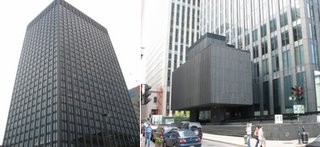
The Black Box is a nondescript Modernist structure, clad in black granite with dark windows. Unbelievably, it faces onto an historic square that is framed on three sides by the Basilica of Notre Dame de Montreal , a wonderful old Art Deco building, a red brick structure from 1888, and what looked to be an old government building.
What this moronic piece of crap is doing here in this beautiful setting is anyone’s guess. Apparently Montreal’s city planners wondered how it got there, too, because after it was completed, and people had time to contemplate what was lost to build it, the city passed much more stringent requirements for new construction and renovation.
It was too late, however, to save millions of eyes from this monstrosity. The building itself is bad enough, because of its banal design and its incongruous location. But as bad as it looks on its own, it gets worse. Check out the main entrance to the building in the photo to the right. It is on the side of the structure that thankfully does not face the Place d’Armes.
What in the name of Mies van der Rohe’s bunghole is that supposed to be? Is that floating black box supposed to mark the entrance? Is it meant to be inviting? Is that supposed to be a plaza under there? Few things, other than picking out your own casket, would be as depressing as ducking under that pointless box stuck on a box to get to and from work each day. I think the clinical term for a structure like that is “malignant.” Only seriously invasive surgery or some kind of detonation could correct a hideous attachment like that. The architect should be ashamed, and probably flogged. And maybe he was. The Indignant Citizen has never seen anything that bad anyplace else, so maybe the Black Box was this architect’s—and that term us used loosely here—only building.
Montreal certainly should have known better, given what it had to work historically. But then other cities also should have known better than to build some of the same kind of crap that fouls their skylines.
Buildings like the Black Box suck the soul out of wonderful public spaces like the Place d’Armes and historic downtowns like old Montreal. Maybe one day we’ll tear them down to make room for humanly-scaled and artistic buildings, the same way they tore down whatever was there before the Black Box to make room for it.
There is a lot to say about Montreal, most of it positive. So let’s get the negative out of the way. The Old City in Montreal has some of the most beautiful buildings in the world, inspired by French and Italian styles. These are wonderful, human-scale, ornately decorated buildings. Many of them in the old city were originally offices and are now being converted into luxury condominiums.
And then there’s the Black Box and its Growth.
The Black Box is a nondescript Modernist structure, clad in black granite with dark windows. Unbelievably, it faces onto an historic square that is framed on three sides by the Basilica of Notre Dame de Montreal , a wonderful old Art Deco building, a red brick structure from 1888, and what looked to be an old government building.
What this moronic piece of crap is doing here in this beautiful setting is anyone’s guess. Apparently Montreal’s city planners wondered how it got there, too, because after it was completed, and people had time to contemplate what was lost to build it, the city passed much more stringent requirements for new construction and renovation.
It was too late, however, to save millions of eyes from this monstrosity. The building itself is bad enough, because of its banal design and its incongruous location. But as bad as it looks on its own, it gets worse. Check out the main entrance to the building in the photo to the right. It is on the side of the structure that thankfully does not face the Place d’Armes.
What in the name of Mies van der Rohe’s bunghole is that supposed to be? Is that floating black box supposed to mark the entrance? Is it meant to be inviting? Is that supposed to be a plaza under there? Few things, other than picking out your own casket, would be as depressing as ducking under that pointless box stuck on a box to get to and from work each day. I think the clinical term for a structure like that is “malignant.” Only seriously invasive surgery or some kind of detonation could correct a hideous attachment like that. The architect should be ashamed, and probably flogged. And maybe he was. The Indignant Citizen has never seen anything that bad anyplace else, so maybe the Black Box was this architect’s—and that term us used loosely here—only building.
Montreal certainly should have known better, given what it had to work historically. But then other cities also should have known better than to build some of the same kind of crap that fouls their skylines.
Buildings like the Black Box suck the soul out of wonderful public spaces like the Place d’Armes and historic downtowns like old Montreal. Maybe one day we’ll tear them down to make room for humanly-scaled and artistic buildings, the same way they tore down whatever was there before the Black Box to make room for it.
Subscribe to:
Posts (Atom)

 Posts
Posts

